
Thundercurrent: a loud, intrusive and continuous audio event whose effect reduces over time to a point of perceived inaudibility, an undercurrent, even though still physically present (© David Toop, 2025).
We were thinking and talking about silence: inhibition, tension, magnification, awareness. Silence is an adjustment of listening (active, in the present tense), which leads to hearing (as a reflection, in passing time and memory; not exactly passive, more of a realisation, awareness or revelation). All that was previously outside of awareness is heard. Silence affects time by stimulating a deeper perception of micro-events. Life becomes more detailed, almost as if every event – a floorboard creaking, a cough, a movement, a breath – can be examined as an object, held, turned, scrutinised, rather than being subsumed into life’s layered flow of incident. These were our conversations, taken with us to the chapel at Leigh-On-Sea.
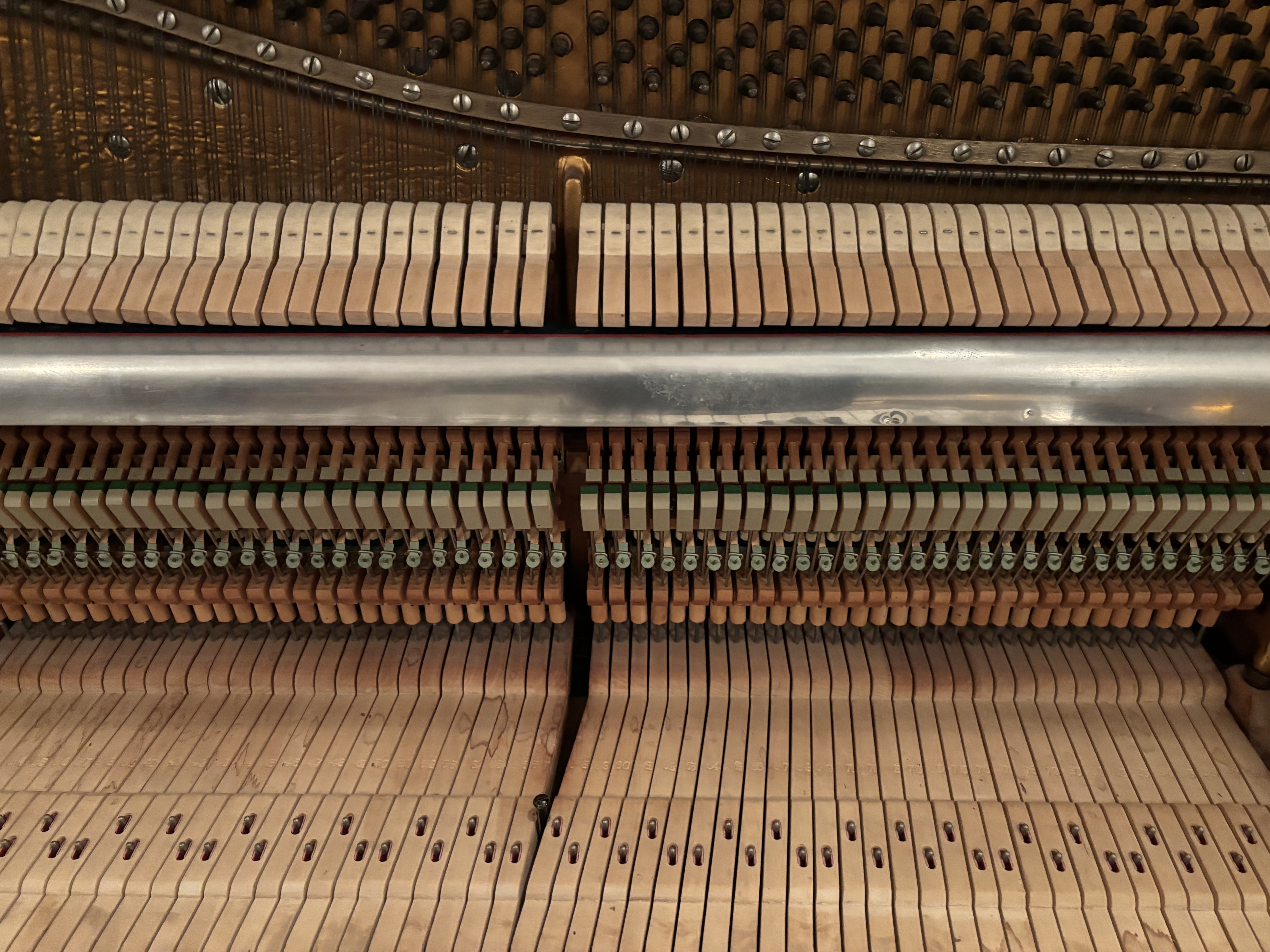
Afternoon. The room was still, unperturbed, its ghosts gathered meekly in far corners where heat had yet to touch. Outside was winter, pretending to be a blue sky. We pushed and pulled at the piano, stripped bare to its wheaten innards, listening to the creak of a floorboard, clock tick, the soft clud of a key’s release, a car passing. The clock was silenced. At this point there was no clear idea. Then Ania pressed keys, each one responding to its own friction, felt hammers rising and falling in grace without ever touching their corresponding strings except when fingers lose control, exert a fraction too much pressure and then a clear note rings out. Accident. Wait. Decay. Silence. Continue: slowly toward the bass, in silence, as far as this is possible.
This process became the beginning of the piece, instruments close to the edge of silence, a friction, a body, a pressure, a waiting. Everything flowed from the silence of the piano.
In one corner of the Fishermen’s Chapel in Leigh-on-Sea there is a pipe organ. A musician was curious so the organ was switched on for a demonstration, its air pump dramatically throbbing into life within a wooden box next to the piano. Gradually the room filled with activity and conversation; the organ was forgotten, the noise of the pump gradually absorbed into social chatter, soundchecks and movement.
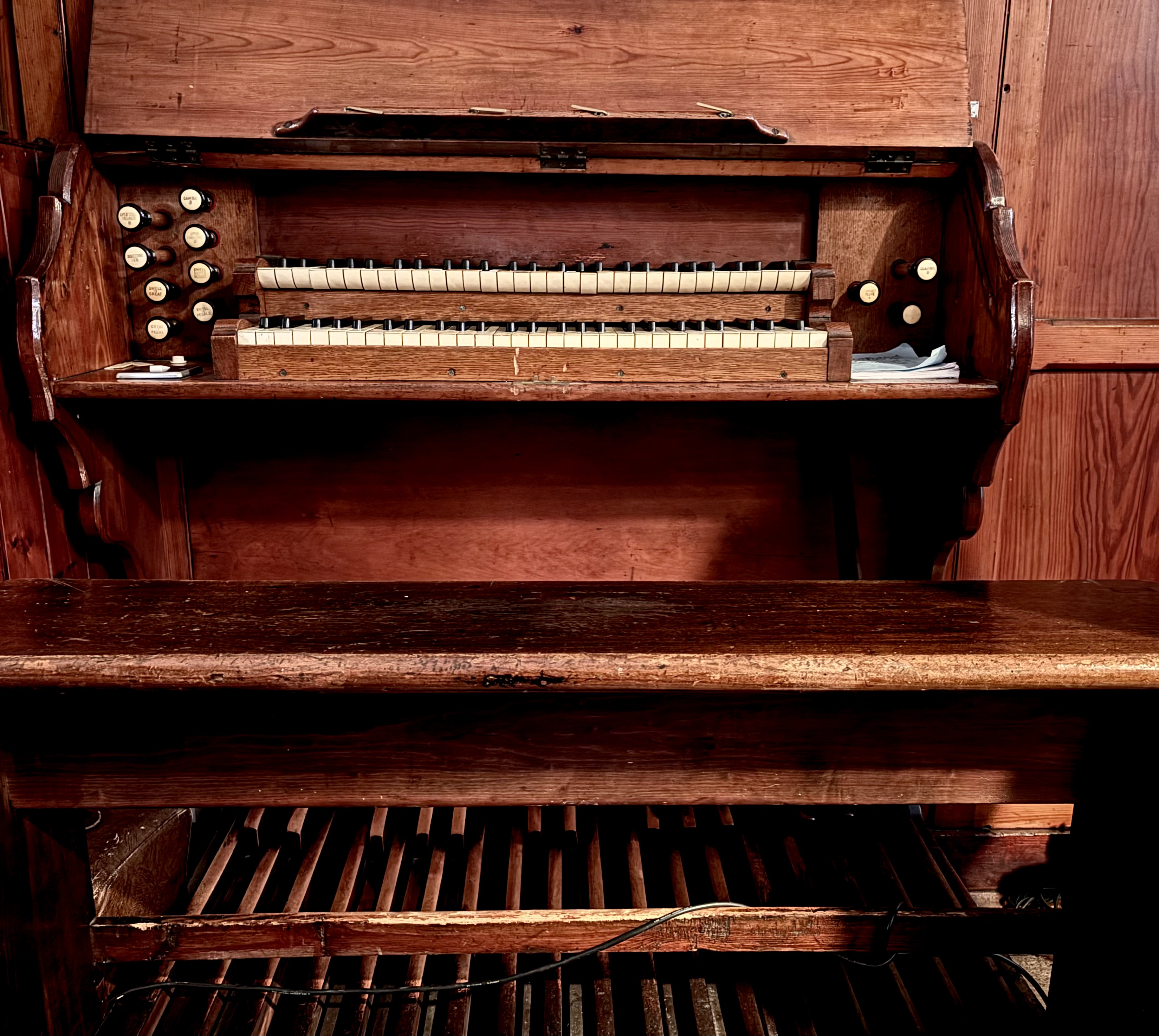
At the beginning of the evening, Levente Dudas, curator and organiser of the event, introduced our duo (moreskinsound, myself and Ania Psenitsnikova). I sat close to the piano, waiting for Ania to begin the piece. We began (in silence, we thought). At that critical moment I realised the organ pump was still running, its noise so insistent and hungry that it would consume the silence necessary for the extreme quiet of our performance. There was no silence. The silent piano keys, the accident of a shell striking a string, the bowing of a leaf or the rustle of paper (all unamplified) would be obliterated. This moment was both very long and very quick. To continue (pointlessly) or to crack the fragile shell of the performance? I took the latter course, moved to switch off the organ pump, then realised I had no idea which switch to flip. Lev Dudas moved quickly to the correct switch and with his decisive action the pump subsided, an expiring breath, death of a monster.
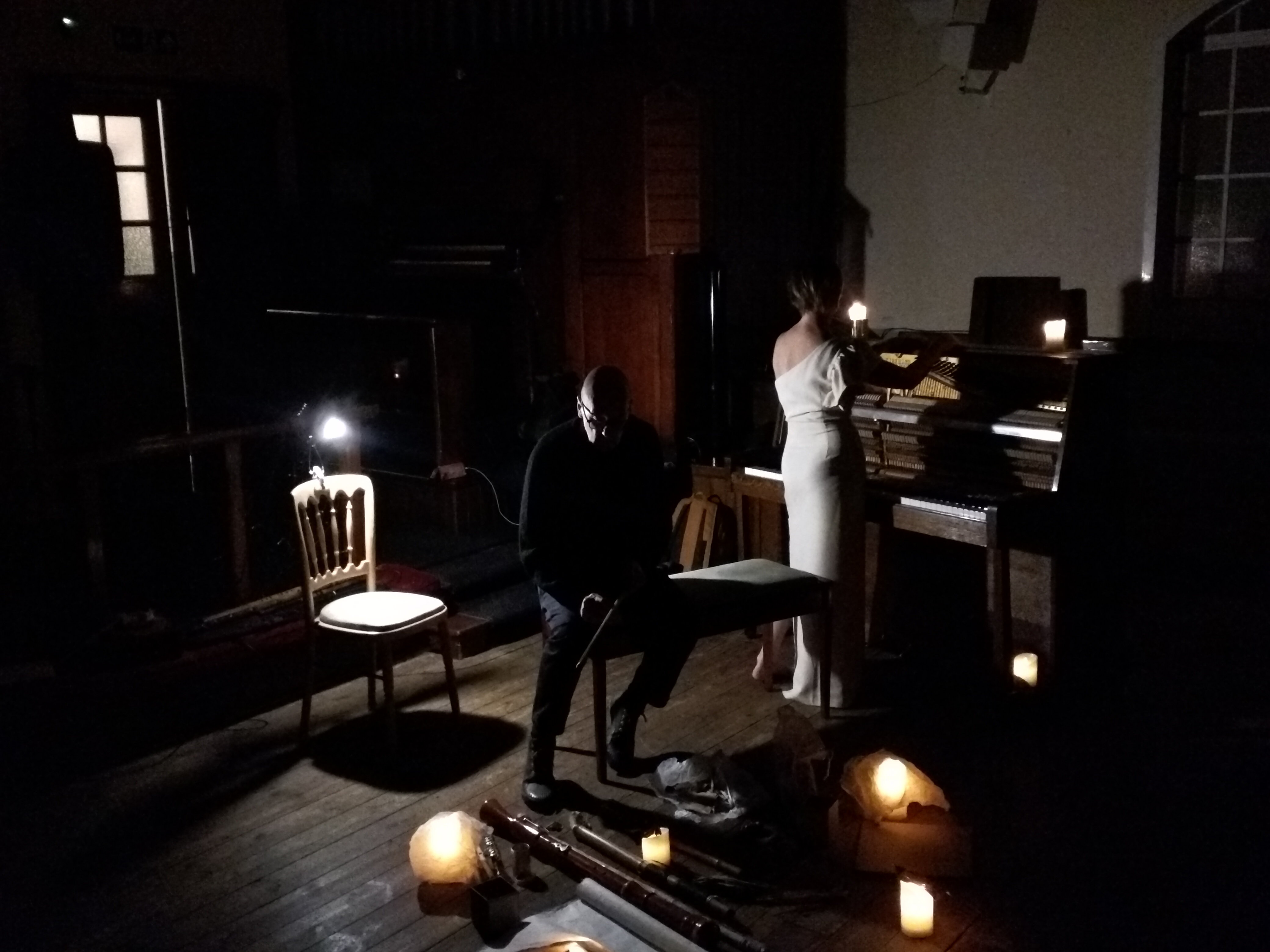
A new moment, this one shocking, revelatory, as a true silence swelled to fill the small building. What are the characteristics of silence in this situation? Transparency, for one. Focus, as if all that was vague and familiar fully inhabits space, and empathy for the liveliness of things in motion and at rest. Air clears. From that point the performance evolved easily, not a silence so much as a building up of empty spaces, entering and delineating them with movement-sounds (sounds as movement; movements that produce sounds, or not). We performed for 27 minutes. Some of the audience suffering from winter coughs found it challenging. At the end, somebody said it was the quietest thing they had ever heard.
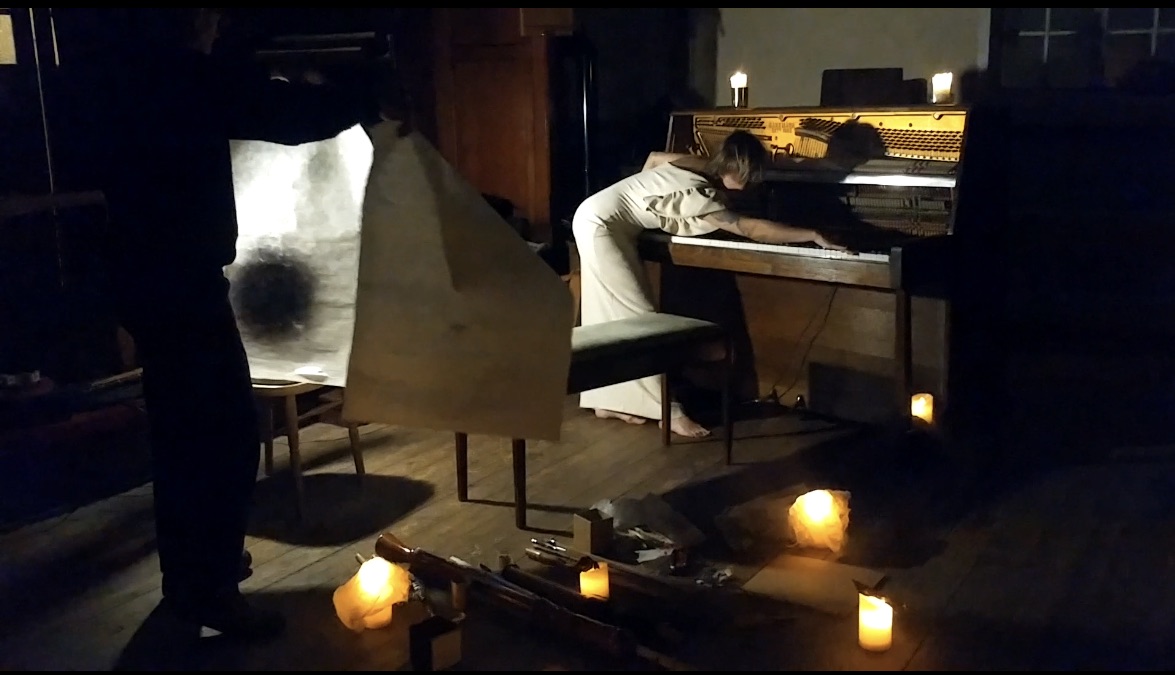
Afterwards I reflected on the air pump incident as an extraordinary though not unfamiliar phenomenon:
1/ that the brain’s processing of sound can reduce our perception of a loud noise to the point of inaudibility, despite its ongoing, unchanging physical existence.
2/ the act of initiating a performance state of attentiveness can forcibly restore this noise to its true state of disturbance, with the further possibility of eliminating it.
Moreskinsound performed at Konsztrukting Soundz #11, the Fishermen’s Chapel, Leigh-On-Sea, 25 January 2025, organised by Levente Dudas. Photographs of Moreskinsound by Levente Dudas. Photographs of the Fishermen’s Chapel by David Toop.


 davidtoop
How interesting David!
This work of yours, seems like an artistic inquiry into our conscious and subconscious awareness. My entire PhD thesis argues that “a language of the senses” is based on vibration in hearing, seeing, speaking and feeling.
Thank you. Wish I could have been there.
Best wishes from a very cold Toronto winter.
Bob
robert appleton | agi | mfa visual music artist, designer phd candidate, york university bob@robertappleton.com cell +1 416 457 8606 art: https://www.robertappleton.com/video music: https://www.facebook.com/media/set/?set=a.10160806772402485&type=3 design: https://a-g-i.org/user/robertappleton research: https://www.researchgate.net/profile/Robert-Appleton
>
Wonderful. And I wish I’d been there.