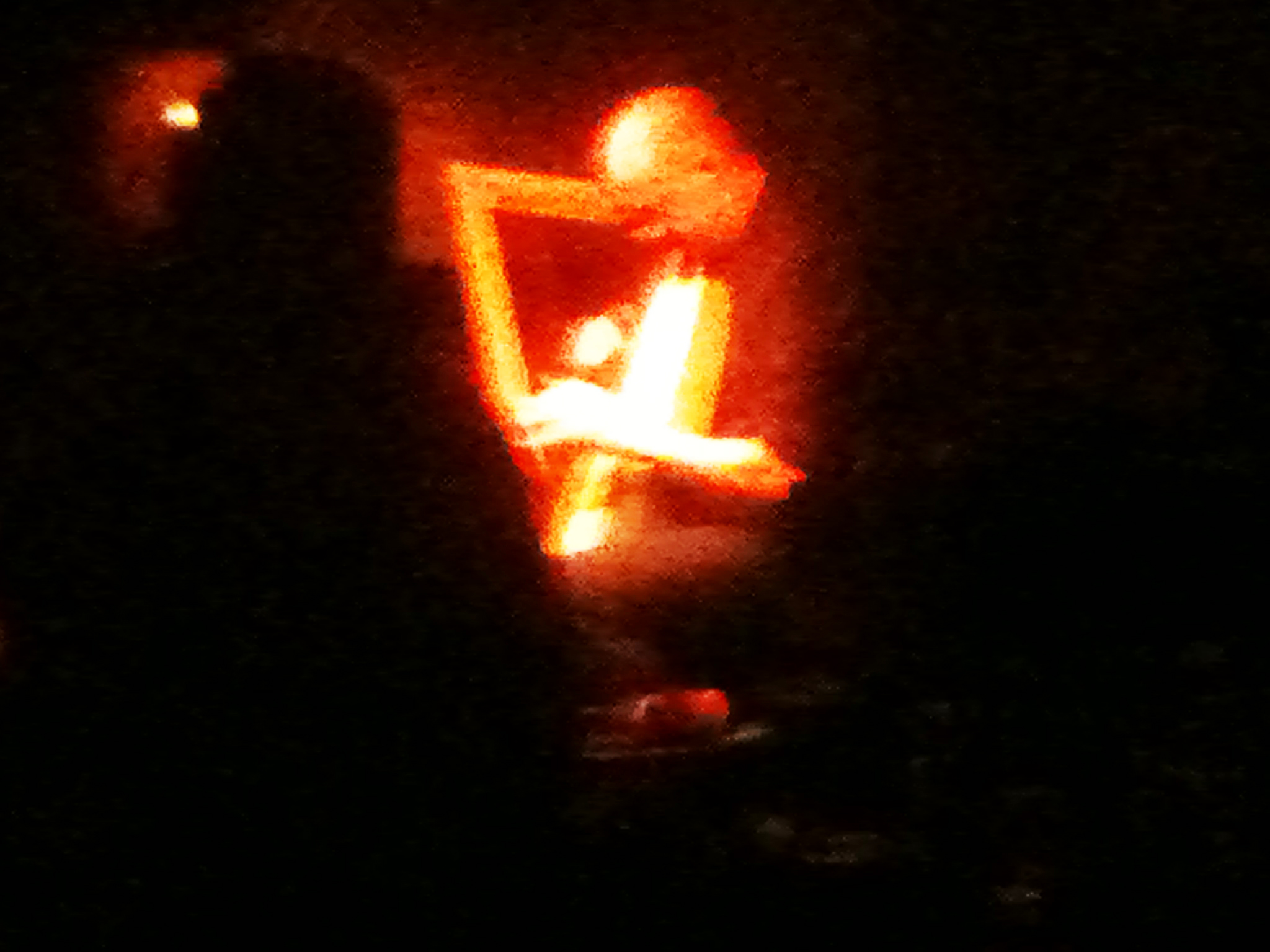
harp on fire: Rhodri Davies

Recently I’ve been watching YouTube clips of Max Wall performing in his role as Professor Wallofski – http://www.youtube.com/watch?v=fEU8Hr4nqV8. The weirdness of antiquity hangs over this kind of comedy but unlike other entertainers of the Music Hall era, Wall’s influence (on John Cleese and Les Dawson, for example) is clear and his abject yet distasteful persona, tattered creature of the night who has fallen into the wrong world, is compulsively creepy. Part of his professorial status is earned through a piano whose presence requires not only music but a configuration of the body. Wall’s arachnid body malfunctions under the pressure of this demand (not uncommon among virtuosi); his wrists go floppy or one arm becomes shorter than the other, must be extended and then compared in a routine that addresses the piano as a near-silent phantom of cultural rectitude, patient and implacable in its search for the perfect human specimen.

All musical instruments come with baggage. In fact they are baggage – objects of surrealist furniture that speak. Smash them, burn them, build them in funny shapes or digital simulacra and yet they grin back: “still here”. Seeing Rhodri Davies set himself up to play amplified harp at Café Oto last night reminded me of Max Wall, not because Rhodri gurns, suffers limb rubberisation or wears black tights but because the instrument is the ventriloquist doll that has the last word. Whatever you do to me tonight, I am the harp of your childhood and all childhoods, it says. Now do your worst.

The enactment of that drama is gripping. He picks up a wooden harp, a sharp triangle small enough to be cradled on the lap like a miniature dog, and before a note is sounded I’m reminded of something else, a little book once published by the British Museum: Ancient Musical Instruments of Western Asia. The cover showed a photograph of a reconstructed silver lyre from the Royal Graves of Ur, found in what is called the ‘Great Death Pit’ and dated c. 2600-2400 BC. Lyres and harps, flutes, rattles, bells and scrapers were ritual instruments in ancient Mesopotamian civilisation. Something similar was true for Japan, Korea and China. We can read about this in Arthur Waley’s translations of The Nine Songs, Chinese wu (shaman) songs from before the fourth or third century BC: “The zithern-strings are tightened; drum answers drum. The bells are beaten till the bell-stand rocks. Sound of flute, blowing of the reed organ; a clever and beautiful spirit-guardian.” In Nara, Japan, housed in Todaji Temple’s Shosoin collection, is an eighth century triangular harp called a kugo. According to Toshi Ichiyanagi, who reconstructed the instrument for his Ancient Resonance project, there is an image of an angel holding a kugo in Buddhist murals within the cave temples of Dunhuang in Western China (also the site where the Diamond Sutra of 868, the world’s oldest surviving dated printed book, had been hidden for centuries until discovered by a late 19th century Taoist monk called Wang Yuanlu).

Like the wood inside the silver casing of the Ur lyre, all of this venerable history and ritual significance decomposed to dust during the ruthless 20th century prettification and trivialisation of harps, flutes and bells. Is it too far fetched to imagine some bonus-swollen investment banker keeping a harpist chained to a radiator below stairs on permanent call for dinner parties? Probably not, but it’s one job that Rhodri won’t be offered any time soon. Just switching on the amp set fire to that particular model of civilisation – the unleashed hum was enough to trigger anxiety attacks in any sound engineers and audiophiles present. Maybe it comes as shock, hearing a musician more closely associated with quietism and minimalism playing in this way. He strikes the strings hard, repeating arpeggios over and over, restricting himself to one area of the harp; stopping, then resuming with a close variant in another area. The playing is expert but rough, as if he is pushing himself to play at the edge of error, rather than training himself (as he must have done in the past) to play cleanly and precisely. After a while he wipes sweat from his head. This is effort, though not for me as a listener.

As a strategy it sounds unusual in the context of music which follows a long symphonic arc (true for a lot of so-called experimental music that I hear out and about). There’s no attempt to resolve anything, to ease in like a cat or conclude with a chocolate or a firework. Each piece is a cell, a version of what came before and what will come after; they begin, they stop. Mostly he plays with distortion, sometimes extreme, and when the strings seem to tumble over each other like church bells in a Bosch nightmare then I think of the green-cowled harpist creature mounted on a screeching primeval monster in The Temptations of Saint Anthony.

Listening to his new vinyl, Wound Response (www.altvinyl.com) a few days before this gig made me think of a tradition that has nothing to do with the sort of music you might hear at that other Boschian nightmare, the Classical Brit Awards. Immediately I heard echoes of Konono No 1 or the Kasai Allstars from Kinshasa, the donso ngoni hunter’s harp from Mali and Guinea, the Ethiopian begena recorded by Ragnar Johnson, the harps and lyres recorded by Hugh Tracey in southern and eastern Africa, the nyatiti harp recorded by David Fanshawe in Kenya, the inanga trough zither recorded in Burundi by Michel Vuylsteke. The latter is famous for its whispered vocal, to our ears sinister but apparently pitched to cut through the frequency range of the strings. There were no whispered vocals forthcoming at Café Oto though Ragnar Johnson’s recording of a song of the Monophysite Church of Ethiopia, accompanied by the deep buzzing of the begena, the harp of David, might have been appropriate since the words dwell on the transitory nature of life on earth: “It will eat you, and even the earth will eat you, like an ignorant man, like a man easily deceived.”

I also thought of another record that arrived in the same week as Wound Response, the freshly remastered CD issue of King Crimson’s Larks’ Tongues in Aspic. Jamie Muir’s involvement in this version of the band was big news in 1972 and although the extreme physicality of Jamie’s performances are absent on the recording, there are glimmers of what might have been. Most exciting to me was the opening of the title track, a very African influenced introduction that suggested a new approach to the interaction of instruments and rhythms in rock music. Whatever the potential, there was always a song or a crunching onslaught of power riffs to blow it aside. I can imagine that Rhodri might have been asked to join the band on the strength of his new direction, were this 1972, and probably lasting as short a time as Jamie Muir.

But in the end this is not just about the hegemony of the harp of politeness or about formal directions in music. It’s about a prevailing mood. “The Theatre of Cruelty will choose themes and subjects corresponding to the agitation and unrest of our times,” wrote Antonin Artaud in 1933. Rhodri quotes Kazimir Malevich on the cover of his record: “and may the freed bear bathe his body amid the flow of the frozen north and not languish in the aquarium of distilled water in the academic garden.”

On my way home from Café Oto I was forced to walk for the last part of the journey. A car was on fire in a side street, smoke pouring from its already blackened body. Somehow it seemed a fitting end to the evening.
Posted in instrumentality, into the maelstrom, live sound | Tagged , , , , , , | 5 Comments

Star-shaped Biscuit: haunting, spells, a drowning world

“The winter is the time of transformation and haunting, not necessarily hostile revenance, but the cold dusk offers access to a past that is almost overwhelming.” The Idea of North, Peter Davidson

In the mid-1930s, photographer and painter Dora Maar (also Picasso’s lover and model, seen in the portraits he called The Weeping Woman) bought a small star-shaped casket in a Parisian flea market. Inside was the fragment of a star-shaped biscuit. This fetish object was once the property of the eccentric French writer Raymond Roussel who had attached a label to the box: ‘A star originating from a lunch I attended on Sunday, 29 July 1923, at the Observatory at Juvisy with [astronomer and spiritist] Camille Flammarion presiding.’ The star-shaped biscuit passed into the hands of French surrealist Georges Bataille (Dora Maar’s lover between 1933-34), who spoke of being troubled by the object. ‘[Roussel] obviously wanted to appropriate to himself this edible star in a manner more important and actual than simply by eating it,’ he wrote. ‘This strange object signified for me the way in which Roussel had achieved his dream of eating a heavenly star.’ For Bataille, the biscuit was not unlike Proust’s madeleine, an unlocking of buried dreams and memories, a mythical object that can release ideas, images and myths for past, present and future. Others might think of it as the Roman Catholic sacrament (encased and ‘shown’ in its solar, or star-shaped monstrance), the various shape-changing foods eaten by Alice in her Wonderland, or the plant hallucinogens used in shamanic séance to effect travel between the worlds of the living and the dead.

A ghost story, perhaps? In a draughty room, on an island in a remote place (somewhere like Iceland, or a small island off the coast of Ireland or Japan), Dora waits implacably for apocalypse, the end of everything, a great silence. She waits for water to cover her island as the great melting returns us to the sea. Her external environment shrinks, submerges, just as her inner life moves toward a central core of silence, and in this state of suspension she travels through a land of death and memory, searching for ways to write and rewrite her story, particularly that part of her story written by others. The image of her as the Weeping Woman is broken down and reassembled like a puzzle that resists completion.

The setting: a space that seems ghostly and shadowed, the ground covered with burned tree branches, dry leaves, ashes, old machines, the ruins of the past, a consequence of some catastrophe. Dora has very little: a low table which serves also as a bed; a great book – disintegrating, worm-eaten, exuding red and brown powders – of her journals and diaries; water in a bowl, and a fetish object, a memento – the star-shaped biscuit. There are outbursts of anger, re-enactments of a breakdown, the inflicting of electric shock treatment. In her loneliness, she sings and speaks aloud to activate the still air of her solitude, ‘to set the darkness echoing’. Her memories are interwoven with spells recited to conjure the past. The air is alive with whispers, strange sounds, haunting echoes, as if the voice that she projects into space echoes back to her as stranger, usurper, saboteur.

The room is occupied also by two presences, or spirits. Their names are Euphrosine and Seabrook. Euphrosine seems to come from the 18th century, a character from a Fragonard painting or a story by the Marquis De Sade. Seabrook is an adventurer from the 1920s. They could be described simply as ghosts or revenants representing the errors of history but they can also be read as traces of Dora’s memories, as elements of her unconscious, or as manifestations of spirit guides who have been raised by her spells, her involuntary actions, her dreaming and the effects of isolation on her interior self. Like the puppeteers of Japanese bunraku, they are ‘invisible’ to her. Signs of their existence are only partially and slowly evident to Dora, as ghosts, apparitions, or auditory hallucinations, or as ambiguous, fleeting moments of feeling in which differences between outer reality and the inner life of the mind are uncertain. Without quite knowing what she is doing, she casts spells. Somehow, the presences are conjured, though she is only partially aware of this consequence.

When she rests, they slip into other times and places to enact their own past confrontations with voices of bewitchment and entrancement. Dragged back into the light, Seabrook examines his delirious fascination with exoticism. Euphrosine follows his example, exploring the myth of an operatic voice so powerful it could kill. Dora is drawn by these two liminal presences, conjuring them up, yet resisting their persuasive imprecations to pass over those faint boundaries that delineate the worlds of life and death. The star-shaped biscuit, the heavenly star, also pulls her back into nostalgia, history, the repeated mistakes of the past whose consequence is the catastrophe that has left her isolated in a drowning world. Should she eat the magical biscuit and fade back into the past or confront the unknown void ahead?

The text:

Voices are everywhere: the sotto voce comments and responses of singers to the main voice, along with recorded whispers, low voices and murmurs are heard all through the piece as an undertow that interweaves with sung voices, a confusion of stories, invisible presences, angels and devils, interior monologues and passages quoting either directly or obliquely from Dora Maar, and from other stories of island exile and haunting such as Defoe’s Robinson Crusoe and Shakespeare’s The Tempest; from Mary Shelley’s Frankenstein, Edgar Allan Poe’s The Narrative of Arthur Gordon Pym of Nantucket; Zeami’s 15th century Noh play Tsunemasa; writings by those associated with Dora Maar, including Jacques Lacan, Pablo Picasso, Jean Cocteau, Andre Breton and Georges Bataille; by anthropologists and artist-explorers such as William Seabrook, Maya Deren, Henri Michaux and Antonin Artaud, by authors such as Vernon Lee, Virginia Woolf, Joseph Conrad, Marcel Proust and James Joyce, from Hans Anderson’s The Snow Queen and Peter Davidson’s book, The Idea of North, and from Benjamin Britten’s Parable for Church performance, Curlew River. These fragmented texts set up polyphonies, interruptions, implications, interrogations and choruses out of which the live voices emerge.

  • Star-shaped Biscuit is composed by David Toop for electronics and a select group of vocal improvisers and multi- instrumentalists.
  • Cast: Lore Lixenberg (Dora), Elaine Mitchener (Euphrosine), Jamie McDermott (Seabrook), with Sylvia Hallett (viola, sarangi, saw, hurdy gurdy, etc), Hélène Breschand (electric and concert harps), Jan Hendrickse (bass flute, ney, bansuri, noh flute), Martin Allen (percussion, vibraphone), Simon Allen (percussion, strings, saw, glass).
  • Star-Shaped Biscuit, Saturday September 15th, 7.30pm,Derelict Building 9, Snape Maltings
Posted in star-shaped biscuit | Tagged , , , , , | 6 Comments

falling under a charm: Rie Nakajima

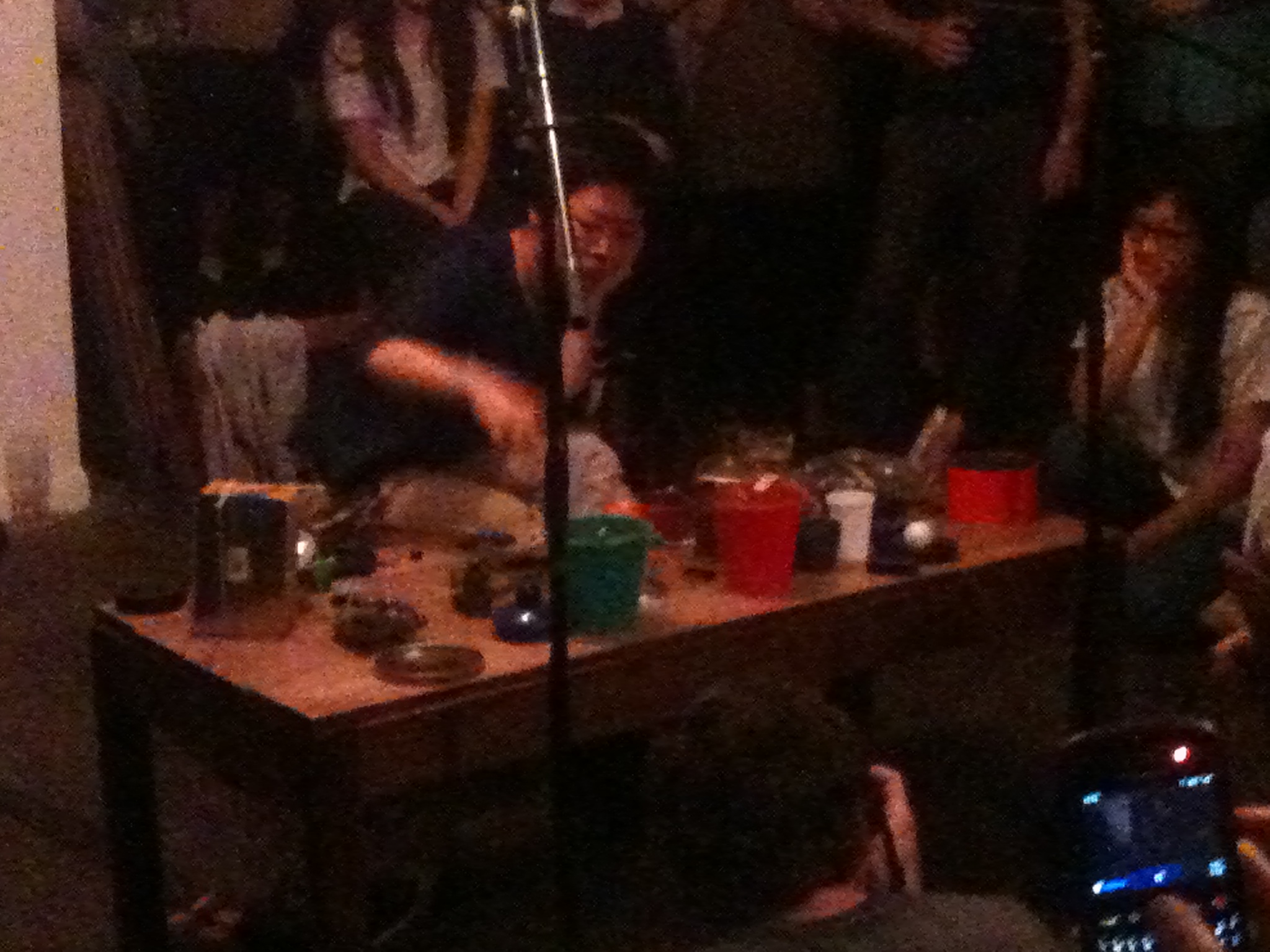
Café Oto, London, 22 August 2012, after 9.00pm: a warm night; the place is quite full. A low table, facing the stage area. Sometimes children lay out old and unwanted toys on the pavement, sit together and hope to sell a few things. This is what it looks like: plastic pails, cups, wires sprouting here and there, electrical scraps, unknown devices. Rie Nakajima sits with the quiet authority of a proprietor supervising her market stall. She activates without performance. We are rapt.

Perpetual motion begins, a ticking; surfaces vibrate. Rhythmic cycles pass in and out of phase as if the watchmaker has drifted into reverie. But she is attentive, observing her children, keeping them out of trouble. She pours small materials, beads maybe, into a cup, upends it onto a vibrating plate, lifts a ping-pong ball from its pulsing surface, carefully upends another cup of small materials onto this same surface. Whatever is now hidden inside – these colourful plastic grains – dances in the dark.

Time passes quickly, in fascination, perhaps because the room has become a complex clock mechanism, hushed and busy, its ticking moving in all directions as if time is a dismembered body, wandering away from itself. There is no such thing as ‘moving forward’; stop using that expression now, or then, or ever.

Then she stops, looks up, smiles. This segment of time within an evening of music is marked by an ending. There is long applause (because we have all been drawn into the charm of small magic) but the machines continue for some time afterwards. Like insects, they have no interest in humans, their ideas of performance, the rules of engagement.

Café Oto is a remarkable venue but one of its disadvantages is the lack of escape. Very few improvisers listen to sets by other people if they are preparing themselves to play. I’m not a virtuoso musician. I don’t practice for hours every day, nor do I play regular gigs. Everything I do is about questioning and instability. Hearing a brilliantly executed improvisation just before I play can be disastrous. Doubt creeps out of shadow places, insinuating itself into the field of potentiality. “Why can’t you play like this?”, Doubt asks me. “Why do you have to play so quietly, so loudly? Why are you not better at what you do?” I have no answer.

Excitement is also a problem. Normally I don’t want to get excited about anything before playing. Derek Bailey once told me that he had turned age to his advantage. The promoter would assume he was exhausted from travelling or just from being alive for so long. “Please go and lie down,” the promoter would say and Derek would happily do so because it meant he didn’t have to engage in conversation with anybody and get distracted from the job in hand: to play.

Yet I felt excited by this small magic – Rie’s section of the evening – and felt energised, ready to play almost immediately afterwards, free from the creeping questions of Doubt. This evil of Doubt can be unleashed by musicians whose fierce singularity of purpose crosses over into narrow dogmatism, as if their work is a weapon designed to eliminate all that is not them. As an artist Rie seems to possess that singularity but her composure and concentration turned out to be liberating, perhaps because the performance mixed strong self-determination with deliberate passivity.

David Cunningham was in the audience and as I watched him watching her I recalled words written by Richard Cook for the sleevenotes of General Strike’s album, Danger In Paradise. The music made by Steve Beresford and myself in David’s Brixton studio, might, according to Cook, “have been drawn from a particularly industrious afternoon concert in an elves’ toyshop.”

Others came to mind: Pierre Bastien, his Mecanium and trumpet (though Pierre is more of a Geppetto to his mechanical orchestra of Pinocchios); Max Eastley’s sonic automata (part sound installation, part artificial life); the small sounds of Rolf Julius (particularly his beautiful recording with Miki Yui) and Akio Suzuki’s way of casting a spell with the simplest of devices. I also though of kinetic sculptor Pol Bury, whose infinitely slow-moving microaudial sculptures bewitched me when I first saw them in the 1960s. Yet none of these precursors, if that is how they should be described, feels entirely appropriate; perhaps my closest experience of something similar was a Chiang Mai market stall stocked entirely with electronic bird sounds, all of them playing simultaneously to their owner, a woman whose job it was to be immersed in a perpetual dawn chorus of digital birdsong.

This week I was asked a few questions for a newspaper interview. One of them wanted to know if making music outside formal concert environments was a good idea. My honest answer to that (though not exactly the one I gave) is that you could pick up all the world’s concert halls and dump them in the sea. I no longer care very much about what happens in such places. I care about these moments of falling under a charm.

Posted in into the maelstrom, Uncategorized | Tagged , | 6 Comments

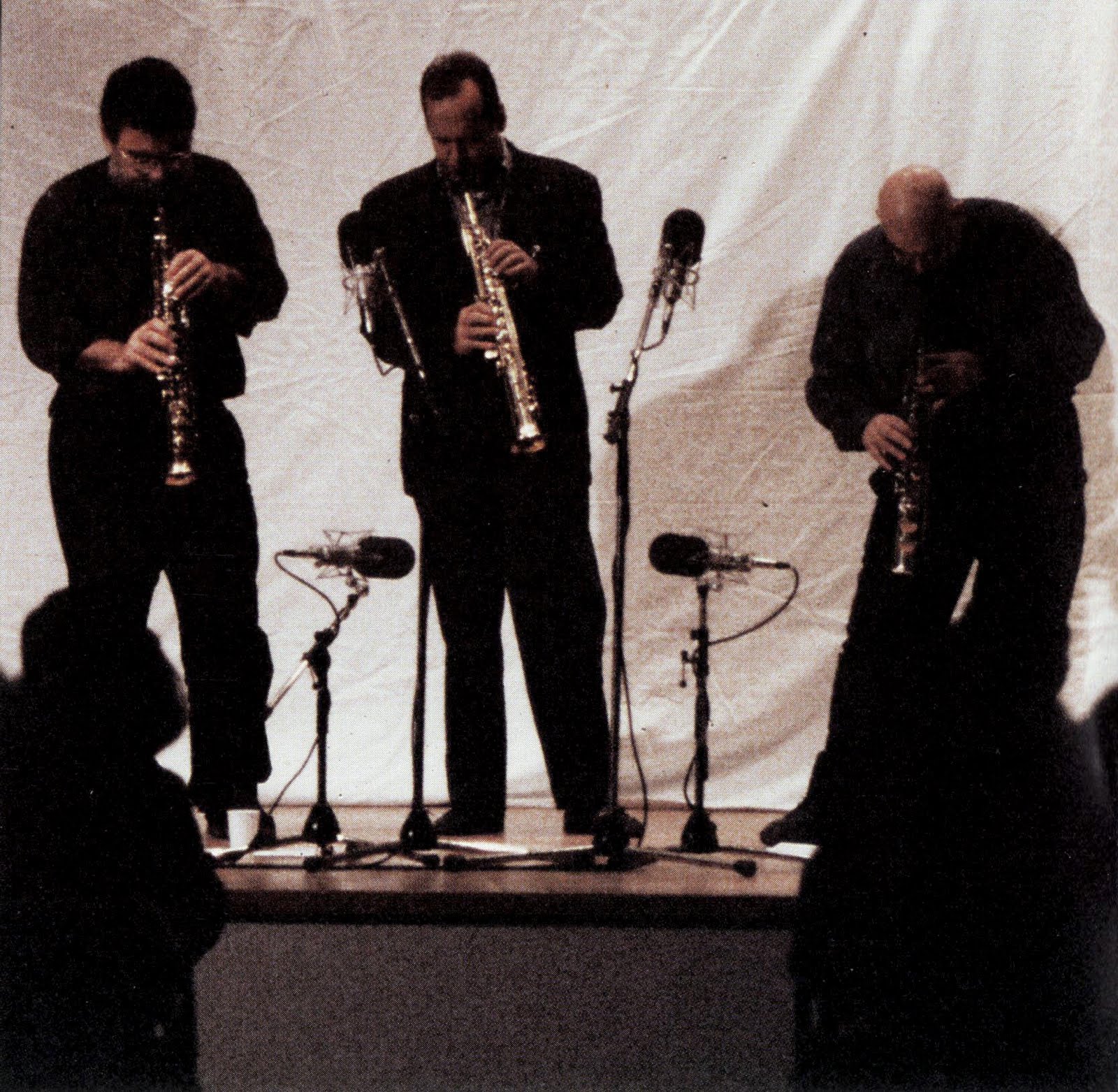
Lol Coxhill, Steve Lacy, Evan Parker: those three blokes

One of the hazards of writing difficult pieces at speed is that assumptions can turn into errors. An email from Evan Parker has set me right on the issue of the “Three Blokes”:

“It seems almost churlish to offer a small correction, but the fact is that
Lacy wrote a piece for the three of us and the title was “Three Blokes” –
it became the title for the whole CD at Jost Gebers request.  It was also the only piece with any prearranged element- apart from the three blokes and their soprano saxophones that is. A bit sad to think that only one of the blokes is left but even sadder to have lost them both.” Evan Parker

Posted in into the maelstrom | Tagged , , , | 1 Comment

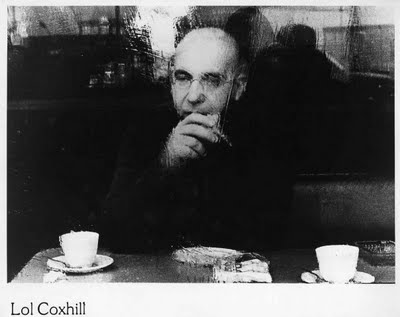
end of play, for Lol Coxhill

Late one night in March of this year I was sitting in an eerie hotel within Tokyo’s Haneda airport being interrogated for a Japanese magazine (see http://onbanjidai.blogspot.co.uk/). The subject of the interview was music and comedy and despite my fear of flying and the knowledge that I was about to board a plane I started talking about “Murder In the Air”, a track by Lol Coxhill and David Bedford. If my memory is correct, I first heard the duo perform this gem of refracted kitsch on John Peel’s radio show in the early 1970s. One of my interlocutors, Minoru Hatanaka, a man who is endlessly well-informed on all things British and experimental, had never heard of it. Perhaps it’s just as well; what would a Japanese person make of this gently absurdist parody of a drawing room melodrama of the 1930s? Even the Noh drama is less opaque.

But as an autonomous piece it had all manner of connective tissues stretched thin enough to touch the edges of trad parodists like The Alberts (for more on this subject see Bruce Lacey’s current show at Camden Arts Centre), the fashion of the time for reviving vernacular musics of the Victorian and Edwardian era as an experimental stance, a comedy legacy that included The Goon Show, Julian and Sandy on Round the Horne, Monty Python, Music Hall monologues, sub-Noel Coward theatricals and Vivian Stanshall, an infernal symbiosis through which the most effete and ephemeral comedies of manners came to represent all that was sick in the British class system and so served as bayonet practice, often by chaps who had undergone National Service and become radicalized (or at least well-equipped for a life of heroic silliness) in the process.

I’d planned lunch today with Rosemin Keshvani, curator of the current Flat Time House exhibition – Better Books: Art, Anarchy and Apostasy – featuring artists who performed or showed work at Better Books in the 1960s, Bruce Lacy, the late John Latham, the late Bob Cobbing, the late Jeff Nuttall, the late Jeff Keen, the late Steve Dwoskin, the late the late the late, and so all of this comes to mind out of early morning thoughts about Bruce Lacey and why it is that these scarecrow figures of the British arts are dragged back from their wasteland exile at the very last moment to perform duties as romantic legends for those too cautious to live anywhere near the same precipice. My questions were interrupted by a text from Steve Beresford: “Lol died last night”. After a certain age you become accustomed to the passing of legends, the chiming of a clock that fades into inaudibility, yet I felt bereft and tearful, not only because I counted Lol as a strange sort of friend and had played with him on and off since 1971, but because he was a person whose way of living, presence, being, conversation, wit and music enriched and challenged your own existence.

In a way I could never get over my awe of him, having seen him for the first time on Ready Steady Go in 1965, a hipster-shaded baldhead tenor player backing up Rufus Thomas’s TV performance of “Walking the Dog” (http://www.youtube.com/watch?v=acX8d_oLxxU). I was crazy about Thomas at that time and so never quite recovered from the impact of Lol’s evident charisma. He was also a member of Kevin Ayres’ post Soft Machine group, The Whole World, along with Bedford and Mike Oldfield. I heard them live twice in 1970 (a Hyde Park Free concert with Robert Wyatt on drums, and then at The Marquee club); the memory that sticks is from the Marquee, Bedford playing organ wearing a huge pair of industrial gloves. Then in 1971 Lol turned up as an invited musician to the free improvisation workshops John Stevens was running for young acolytes like Paul Burwell, Herman Hauge, Ye Min and myself at Ealing College. Immediately there was the sense that he was actively interested and open to engagement in what others were doing, never mind their relative youth and the fact that they didn’t know the changes to “All the Things You Are” in Bflat.

Two things about that. Lol could be an extraordinarily generous person. There were those he believed to be “duff”, dismissed with pithy anecdote and an underplayed chuckle, and then there were those he genuinely liked and admired, often awkward, marginal figures like Colin Wood or Dave Holland (the pianist) who lacked his breadth of experience but who gained his respect through the tenacity with which they maintained their awkwardness and marginality. He actively sought out tricky situations. To me, this is the measure of an improviser: a player who moves beyond their comfort zone, chips away at their own aesthetic and tics, risks foolishness and failure and yet builds operational spaces in every situation, no matter how rote or ridiculous. The rest are just stylists. I say this knowing that Lol was never graced with the status of true improviser by the commissars of the game; his sidelines were his centre, his rambling ways the shadowing of his bald soprano, its convolutions and folds, its serpentine unfoldings in the inaudible dark. He was dogged by eccentricity, busking, the look of him, his clothes, his baldness, his comedic turn yet never shied away from the heavy responsibility of lightening proceedings. Some people would release an album by three of the greatest improvising soprano players – Evan Parker, Steve Lacy and Lol Coxhill – under a title like Straight Horn Colossi; no doubt at Lol’s suggestion it was called Three Blokes.

Lol absolutely loved music, and so his raptures could shine equally onto Roland Alphonso or the San Lucas Band of Guatemala, onto frogs or sealions, onto the most sublime tenor players in jazz and the most incompetent shambolic amateur punk bands. He backed or sat in (these odd positional terms) with Joe Harriott and Jimi Hendrix, The Damned and Judy Collins; a collaborator in projects and groups so diverse that the list would be improbable were it not Lol. In the early 1980s I worked as writer and interviewer on Jeremy Marre’s Channel 4 music series, Chasing Rainbows. In Whitley Bay we recorded a wonderful violin duo called Minzi and Mina, two elderly ladies who played deliriously marathon Saturday night sets of yesteryear hits, shakily approximate but spirited, to a lively hotel crowd. Lol loved them when he heard a recording and it made me tearful again to open the gatefold of his Frog Dance LP this afternoon to find this letter: “Hello David . . . hope you like some of it as much as I like Minzi and Mina, cheers! Lol”.

One of the reasons we all loved Minzi and Mina was because they seemed to be the belatedly discovered template for our Brighton beach ensemble, The Promenaders (Lol, Steve Beresford, Peter Cusack, Paul Burwell, Terry Day, Max Eastley and myself). Formed in adversity for beach entertainment, as a reaction to poor organization, the group went on to play its peculiar repertoire many times. Did we support Machito at The Venue or am I dreaming? I know we played at Walter Zimmermann’s Beginner Studio in Cologne and had Coventry art students waltzing around to “The Dambuster’s March” as if the Battle of Britain still raged overhead. As with “Murder In the Air”, the group was a descendant of some odd British spirit of self-subversion, a determination to look ridiculous in order to pass through enemy lines. Being of a certain age, we played a Light Programme selection (Google it, I suggest) in a mode, or in the mood, of studied imprecision but without Lol’s inventive fluency there would have been less than half the laughs. For a C4 television appearance matching tight, white, nylon polo necks and cheap medallions were acquired from a shop in Brixton, along with subsequent skin rashes to the neck and a preponderance of man boobs. I suspect that Vic Reeves and Bob Mortimer may have studied our appearance with keen interest.

The last time I played with Lol was in a quintet – the three Recedents, Mike Cooper, Roger Turner and Lol – supplemented by Rhodri Davies and myself (coincidentally, perhaps, a full set of recedents). Some anticipation had attached itself to this gig, as if the association of Rhodri and myself with so-called ‘New London Silence’ would reduce the five of us to static automata in a curiosity shop, instruments on our laps and waiting for the man with the key. As it transpired the music exemplified the open work, that wonderfully tensile balance of kinetic urgency and reactive restraint that has been a constant in British improvisation since its origins. Lol had played far less than usual yet afterwards he seemed to be perspiring. “It’s hard work not doing much,” was what I remember him saying, the familiar dry delivery ensuring that you knew he was joking and not joking. He was incessantly self-deprecating but he knew he was good; he was shy but would stand out in the biggest crowd. I remember his quick gait, light on the feet for a big man, and his impersonation of Brando at the end of Apocalypse Now: “The horror, the horror”. In the early 1980s there was hope that he could play Dr Moreau alongside Diamanda Galas in an improvised opera devised by Alterations but it never happened so Charles Laughton’s reputation was saved. He was a remarkable man. In 1976 I took a trip to Amsterdam with Nestor Figueras. On the overnight ferry we bumped into Lol. As usual when traveling he didn’t carry much more than a soprano case. After some hours of drinking with us in the bleaching bright lights of a nautical bar he announced a wish to retire for the night, lay down on the floor on his back and immediately fell asleep. Quite why that seems to sum up his path through life as a unique being I am not sure but it does.

Posted in into the maelstrom | Tagged , , , , , , , , , , , , , , , , , , , , , , , , , , , , , , , , , , , | 50 Comments

to rush down

Henri Michaux, Untitled (Mouvements), 1950-51

“Any old wood will do,” wrote Henri Michaux in 1949. The drum needed no skin. Just as long as your whole life could be concentrated into the impact of fingers, hand, fast, faster, less fast, slowly, very slowly. Silence was a great leech lying down within him. “In my music, there is a great deal of silence,” he wrote, but then again spoke of noises, his noise pushing away all others, then night, the self entering further into the sounds, and the pressure to record these sounds, his resistance to the needs of the mechanism, the necessity to watch its functioning and be subdued by its division of time, whereas Michaux was working into the unknown through time, “long boring passages”, or improvising on a drum to auscultate himself, to take his pulse, to make flux in his time, to be against much of civilisation, to break through a dam, “to rush down” . . .

“Since I never went in for playing with sand on the beach as a child – a disastrous deficiency from which I was to suffer all my life – when the age for it had passed, the desire to play came to me, and now to play with sounds.

Oh! what a strange thing at first, that current suddenly revealed, that liquid unexpected, that passage bearing something in itself, always, and which was.

You no longer recognise your surroundings (the hardness has left them).

You have stopped bumping into obstacles. You become the captain of a RIVER . . .

What I want (not yet what I produce) is music to question, to auscultate, to approach the problem of being.”

Henri Michaux, First Impressions, on music (1949)

Posted in into the maelstrom, Uncategorized | Tagged , , , , | Comments Off on to rush down

mouth of shadows

Andre Masson: Automatic Drawing (1920s)

“she speaks to me a language so soft that at first I do not understand . . .”

(Aimé Césaire, Son of Thunder, 1948)

“I have always wondered why automatic writing has not been invoked more in the ever-multiplying number of discussions and positions taken  on ‘composition vs. improvisation’.” Adam Linson, sleevenotes to integument, Lawrence Casserley/Adam Linson (psi 09.03, 2009).

“. . . the air pauses I hear the grating of poles on their axles the air drones . . .”

(Aimé Césaire, Permit, 1948)

. . . a series of magnetic fields . . . On the 23rd March 1941, Claude Lévi-Strauss and André Breton boarded the SS Capitaine Paul-Lemerle, a steamer sailing from Marseille to Martinique. Both of them hoped to reach New York. Lévi-Strauss, Jewish, and Breton, banned writer, Marxist and surrealist, chose exile rather than risk persecution and internment under Nazi occupation of France and the collaborationist Vichy government. They met by accident, subsequently passing the time by discussing the theoretical texts both were producing during the voyage. According to biographer Patrick Wilcken, Lévi-Strauss “wrote a detailed commentary on Breton’s doctrine of spontaneous creativity, trying to resolve the contradictions between surrealist ‘automatic’ art (in which the artist simply writes, draws or paints with no pre-planned ideas, guided by chance and random events) on the one hand, and the idea of artistic technique or expertise on the other. How could artistic creativity express itself through what was merely a reflex of the subconscious? He concluded with the notion of ‘irrational awareness’ (‘prise de conscience irrationelle’) – a kind of creative inspiration that the true artist smuggles into a spontaneous work of art. In reply, Breton wrote of the ‘para-erotic’ aesthetic pleasure derived from art, which distinguished it from impulsive doodles, and concluded that Lévi-Strauss’s idea of ‘irrational awareness’ might itself be produced at a subconscious or ‘pre-conscious’ level.” (from Claude Lévi-Strauss: The Poet in the Laboratory, 2010)

On Martinique, Breton came across another recently arrived refugee from France, André Masson, painter-explorer of automatism, chance and altered states. A discovery of the literary journal Tropiques, found while browsing in one of Fort-de-France’s shops, led Breton to a meeting with the poet of Negritude, Aimé Césaire. Solar Throat Slashed (Soleil cou coupé), Césaire’s incandescent collection of surrealist-automatist poems published in 1948 wrenched automatism, along with the streams-of-consciousness of Joyce, Woolf and Faulkner, away from their attachment to European and American psychology (Freud, Pierre Janet, William James) into the colonial realities of the tropics.

While the limits of pure automatism became quickly apparent – Césair later made politically directed revisions and cuts to Solar Throat Slashed, while Masson’s work had shifted away from automatic drawing by the late 1920s – music seemed strangely indifferent to its potentialities. Perhaps this was because of its greater emphasis on group performance (in which automatism becomes a far more complex process); perhaps because the technical demands of musical instruments discouraged abandonment (the paradox identified by Lévi-Strauss). With a few exceptions, it was not until the 1960s that music begin to coax messages from what Breton, after the aural hallucinations that preceded his automatic writing collaboration of 1920 with Philippe Soupault, The Magnetic Fields) described as the mouth of shadows.

Posted in into the maelstrom, Uncategorized | Tagged , , , , , , , , , , , , | 2 Comments

spooky drums

There are those who would prefer to uncouple improv from the ties that connect it to jazz. Hearing Han Bennink play solo recently (Night of the Unexpected, Spitalfields Festival, London, 16.6.12) reminded me of a few aspects of Han’s playing:

  1. he hits the drums and rims hard, the biff shot as Baby Dodds called it, but as a continuously fluid opening up of acoustic space, a hail of shrapnel rather than a single gunshot accent.
  2. for his first solo LP – Solo, ICP 011, 1972 – he recorded two tracks called “Spooky Drums”.

The original “Spooky Drums” (also in two versions) was recorded by Warren ‘Baby’ Dodds in 1946 for Folkways Records. Three photographs on the cover of the 10” LP show the physicality of his playing, time-lapse shots that reveal the crossing of arms, the stretching of his upper body, a kinesiology that recalls the kind of photographs collected in Incunabula, the book of source materials that Francis Bacon absorbed into his paintings. Like Bennink, Baby Dodds was a showman who used his whole body to give character and flow to sound (as the film clip shows, Dodds used his foot to muffle the tom tom; Han has done the same for many years and I wonder if he has ever seen this clip). But making a show for dancers merged into involuntary action and pathology. Dodds talked of, and played, what he called “Nerve Beats”, “like a guy got the passels [palsy]”; for his shimmy beat, his stomach was said to wobble up and down in perfect time.

According to Frederic Ramsey Jr., who wrote the notes for the Folkways release, the title, “Spooky Drums” was said to be a whimsical thing, an indication of the pleasure of switching through quick contrasts. Elsewhere I’ve read that it was a reference to the eerie feeling of a drummer finding himself alone in a recording studio. Whatever, it’s clear that these are solo improvisations to be considered alongside Django Reinhardt’s “Improvisations” of 1937, Charles Ives’ “Three Improvisations No. 1” of 1938, Coleman Hawkins’ “Picasso” of 1948 and Lennie Tristano’s “Descent Into the Maelstrom” of 1953. Maybe that was the spooky part, in a studio, alone with an instrument, improvising?

Posted in into the maelstrom | Tagged , , , , , , , | Comments Off on spooky drums

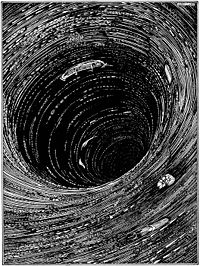
Into the Maelstrom

A Descent into the Maelstrom
Harry Clarke, 1919

in progress, my next book: Into the Maelstrom: Improvised Music and the Pursuit Of Freedom . . .

to research the history and practice of musical improvisation, notably the post-1960s ‘school’ known as free improvisation; to establish the cultural and political contexts out of which free improvisation emerged in the 1960s; to locate the self-organisation of improvising musicians in the 1960s-70s within a broad spectrum of political and social activism; to analyse the backgrounds and beliefs of those innovative musicians who were among the earliest to develop a practice of group improvisation without composer, notated score, conductor or prearrangement; to map the continuing evolution of the music,  its changing practice.

Posted in into the maelstrom | Tagged , , | 17 Comments

Can I get a witness?

my essay for Scanner’s Witness project – David Toop on Witness – can be found online here:

http://www.soundandmusic.org/projects/scanner-durham-brass-festival/david-toop-witness

Posted in writing sound | Tagged , , , , | Comments Off on Can I get a witness?